
Honeywell Air Duct Cleaning in Greenwich Village: A Homeowner’s Guide
Here’s the mistake we see most often in Greenwich Village: a homeowner invests in a Honeywell whole-home air cleaner, then never looks at the duct system feeding it. A Honeywell F300 electronic air cleaner carries a MERV-equivalent rating above 10 when its plates and wires are clean. Put a fouled duct system upstream of it and particulate coats the ionizing wires and collector plates within weeks, dropping effective filtration toward zero. No alert fires. No light comes on. The unit just quietly stops doing its job while the homeowner keeps changing filters and wondering why the air still smells like a basement.
Air duct cleaning in Greenwich Village addresses that upstream problem, and the order of operations matters more than most people realize. If you’d rather not sort through it yourself, call (855) 337-2008.
Why dirty ducts shorten Honeywell filter life
Think of your Honeywell air cleaner as the last stage of a three-part system: return grilles, ductwork, then the filter or collector cell. Every pound of debris sitting in the return ducts is material your filtration has to catch. When the ducts are loaded, the filter or electronic cell does the work of the entire system and loads up fast.
That’s why we tell Greenwich Village homeowners with a Honeywell media cabinet to expect two-month replacement intervals instead of twelve when their ducts are neglected. The filter isn’t failing. It’s absorbing a load it was never designed to handle.
- Media filters (Honeywell and Aprilaire cabinets): loaded ducts cut service life by roughly a factor of several, and the drop is gradual, so it’s easy to miss.
- Electronic air cleaners (Honeywell F300-class): ionizing wires and collector plates foul with fine dust and lint. Washing helps, but if the plates re-foul in weeks, the source is upstream.
- Downstream symptoms: reduced airflow, a musty smell when the fan kicks on, and uneven static pressure across the system.
If your filters are going in clean and coming out gray in a month, the ducts are the first place to look. That’s a diagnostic question, not a sales pitch.
The correct cleaning sequence when a Honeywell air cleaner is in the system
Duct cleaning with a whole-home air cleaner installed is not a one-step vacuum job. Removing debris while the electronic cell is still in the cabinet packs contamination into the plates and can damage the ionizing wires during extraction. The sequence that keeps the hardware intact looks like this:
- Isolate and contain. Negative-air containment keeps disturbed particulate out of living spaces. Our Abatement Technologies units run throughout this stage.
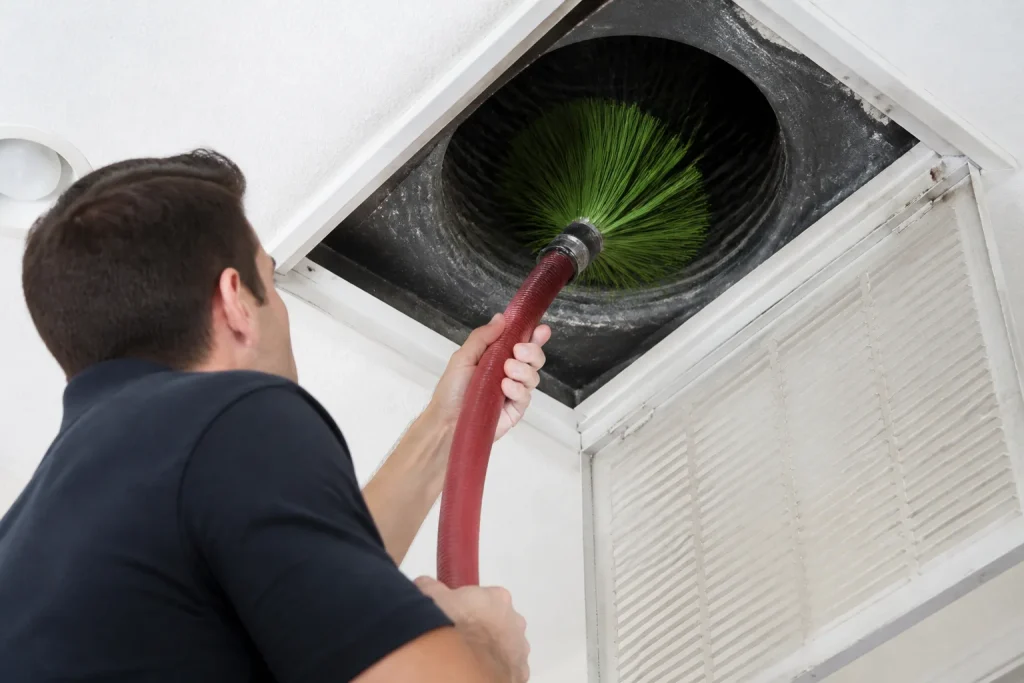
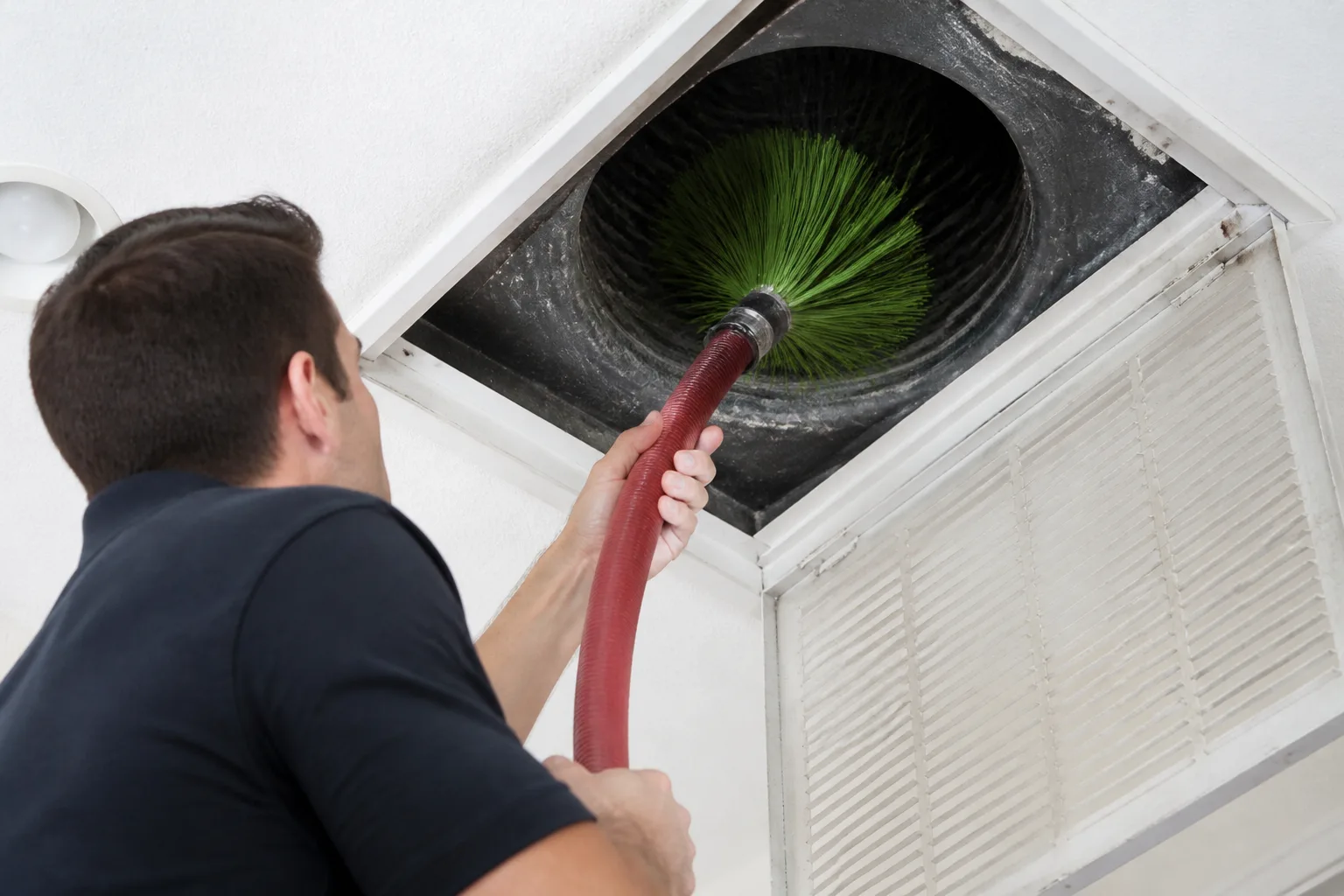
- Clean the duct system first. Rotobrush agitation breaks debris loose from duct walls; Nikro extraction pulls it out. Zones, trunks, and branches get worked in order.
- Service the filter or collector assembly second. Media filters get replaced, electronic cells get removed and washed separately. This is when you inspect ionizing wires for bent or broken strands.
- Calibrate airflow third. With the system clean and the cell reinstalled, verify static pressure and confirm the unit is drawing as designed. This step is skipped constantly, and it’s the one that tells you the job actually worked.
The order isn’t arbitrary. Clean the source, then the filter, then check the result. Reverse any two steps and you’ve either contaminated clean hardware or measured airflow against a dirty system.
TrueZONE dampers and multi-story townhouses
Greenwich Village’s walk-ups and multi-story townhouses often run Honeywell TrueZONE systems with motorized zone dampers. Each floor becomes its own zone, and each damper opens or closes on a thermostat call. This matters for cleaning because a closed damper blocks the extraction path.
During negative-pressure extraction, the crew has to account for damper position. If a zone damper sits closed while the vacuum runs, that branch gets partial or no cleaning, and the homeowner has no way to know. Proper practice:
- Confirm which zones exist and where the dampers sit before extraction begins.
- Command zones open during cleaning, or physically address each branch.
- Verify every damper returns to its correct operating position when the job ends.
- Check each zone’s airflow after recommissioning, not just the main trunk.
A townhouse with three zones cleaned as if it were one is a job that looks finished and isn’t. If a company can’t tell you how they handle zone dampers, that’s an answer worth noting.
UV germicidal lights and sanitizing treatments
Honeywell systems are frequently paired with UV germicidal lamps in the air handler or coil area. These lamps serve a purpose, but they should be deactivated before any sanitizing treatment. UV exposure degrades certain sanitizing agents and can leave the treatment uneven. Power down the lamp circuit first, treat the system, let it settle, then restore power.
Verification after the fact matters just as much. A lamp that was unplugged and never reconnected is a silent failure: the homeowner thinks they have UV protection and doesn’t. Before the crew leaves:
- Confirm the lamp is powered and the indicator shows operation.
- Check that the lamp is seated in its mount and aimed at the intended surface.
- Note the lamp’s install date so replacement intervals are tracked.
Air quality and sanitizing work goes beyond debris removal, and it needs to be done with the equipment in the system accounted for, not around it. Our air duct cleaning scope includes this coordination as standard practice.
What a proper job looks like afterward
You shouldn’t have to take anyone’s word for it. A correctly completed full-cycle service gives you measurable benchmarks to check weeks later. Here’s what to look for after cleaning a Honeywell-equipped system in Greenwich Village:
- Static pressure: measured across the air handler and compared against the equipment’s rated range. If it’s outside spec, something is undersized, leaking, or still restricted.
- Filter interval: a media filter should now run closer to its rated service life. If you were replacing monthly before and you’re still replacing monthly, ask why.
- Electronic cell behavior: plates should stay clean through a normal interval, not re-foul in two weeks.
- Airflow balance: each TrueZONE zone delivering as designed, with no hot or cold rooms that appeared after the job.
- Duct sealing: leaks and gaps found during cleaning addressed on the spot, not handed off to another contractor.
Before-and-after photos of your own ducts are the simplest verification. We document them on every job because “trust us” doesn’t hold up against a photo of what was actually inside your return trunk.
When to call a pro
Some of this you can check yourself: filter intervals, visible dust at return grilles, a musty smell that appears only when the fan runs. But cleaning a Honeywell system properly involves opening the ductwork under containment, handling electronic cells, and measuring static pressure. There’s also the safety side of the air handler itself: electrical components and any gas-fired equipment nearby are not a homeowner project. Our hvac cleaning work treats the air handler as part of the system for exactly that reason. Our technicians have up to 9 years of experience with professional-grade equipment, and if the job calls for it, we can work with your insurer.
Related services in Greenwich Village: if your dryer is taking two cycles to dry a load, dryer vent cleaning reduces fire risk and is part of our service menu. Most HVAC-only cleaners won’t touch it.
The Bottom Line
Your Honeywell air cleaner is only as good as the duct system it sits on. Clean the ducts first, service the filter or collector cell second, calibrate airflow third. Account for TrueZONE damper positions during extraction. Deactivate UV lamps before sanitizing and verify they’re back on afterward. Then hold the job to benchmarks: static pressure in spec, filters lasting their rated interval, every zone delivering.
One flat price per system, agreed before work starts, with before-and-after photos of your own ducts. That’s how we handle it. If you’re in Greenwich Village and need help, Air Duct Cleaning Greenwich Village offers free estimates. Call (855) 337-2008. We answer 24/7. Fast dispatch from 7am to 7pm, Sunday through Friday.
Frequently Asked Questions
Most whole-system jobs here run in the range of a few hundred to just over a thousand dollars, depending on the number of zones, the length of the duct run, and whether sealing or sanitizing is added. Townhouses with multiple TrueZONE branches sit toward the higher end. The written estimate sets the final price, and there are no per-vent charges. Call (855) 337-2008 for an exact quote. Estimates are free.
Because they often skip steps you can’t see: no containment, no zone-by-zone extraction, no airflow verification, and no separate service of the electronic cell. A low bid that leaves contamination in your system will cost more in replacement filters and repeat visits. Ask what containment equipment a company uses and how they handle zone dampers. Call (855) 337-2008 for a quote that itemizes the process.
Ask for before-and-after photos of your own ducts, static pressure readings, and confirmation that zone dampers were returned to operating position. We provide all three. If a company can’t show you what was inside your system, you have no way to confirm anything was removed. Call (855) 337-2008 to schedule.
Every few years for most Greenwich Village homes, sooner if you’re replacing filters far more often than rated or noticing musty odors when the fan runs. Multi-story townhouses with several zones and heavy occupancy can run closer to the shorter end. The filter interval is your best ongoing gauge. Call (855) 337-2008 if it’s been shortened for no clear reason.
Written by the team at Air Duct Cleaning Greenwich Village.
Need Air Duct Cleaning Help?
Call Air Duct Cleaning Greenwich Village - the local pro we connect you with is licensed and insured, with free written estimates in Greenwich Village.
(855) 337-2008