
How to Choose the Right Air Duct Cleaning Company in Greenwich Village
Choosing an air duct cleaning company in Greenwich Village comes down to one thing: can they prove they’ve worked inside this building stock? Walk down any block of pre-war co-ops and converted townhouses and you’re looking at ductwork older than most of the companies advertising to clean it. A certificate on a website tells you they passed a test. It doesn’t tell you whether they can navigate a 1920s plenum run, spot vermiculite insulation before a brush starts spinning, or notice a gap in the trunk line while they’re up there. That’s what this guide is about.
What Equipment Does a Qualified Duct Cleaning Company Actually Own?
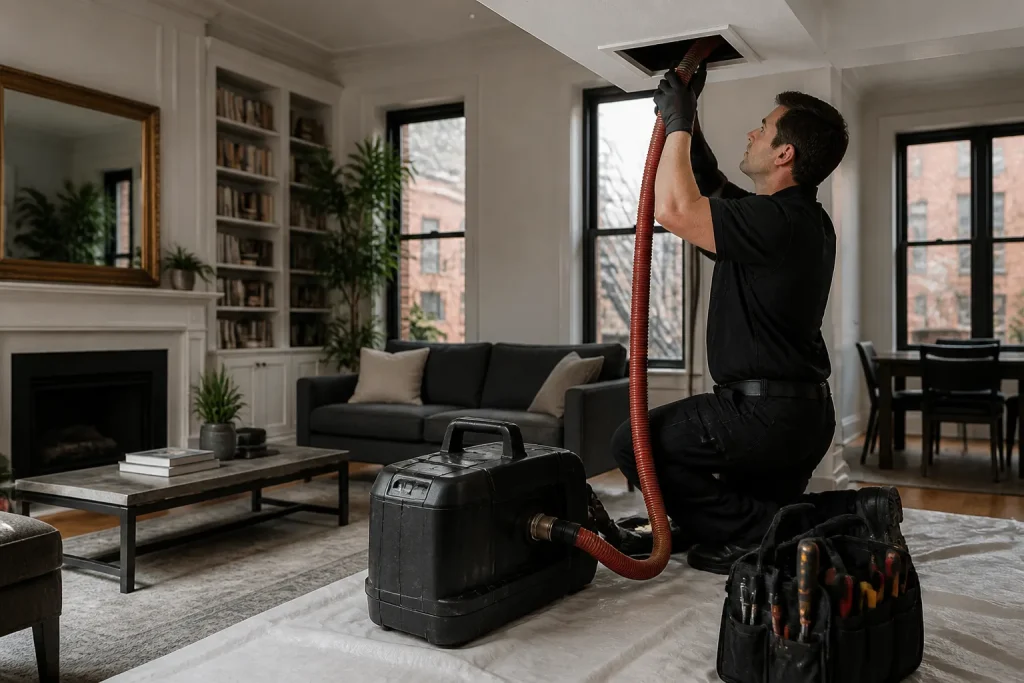
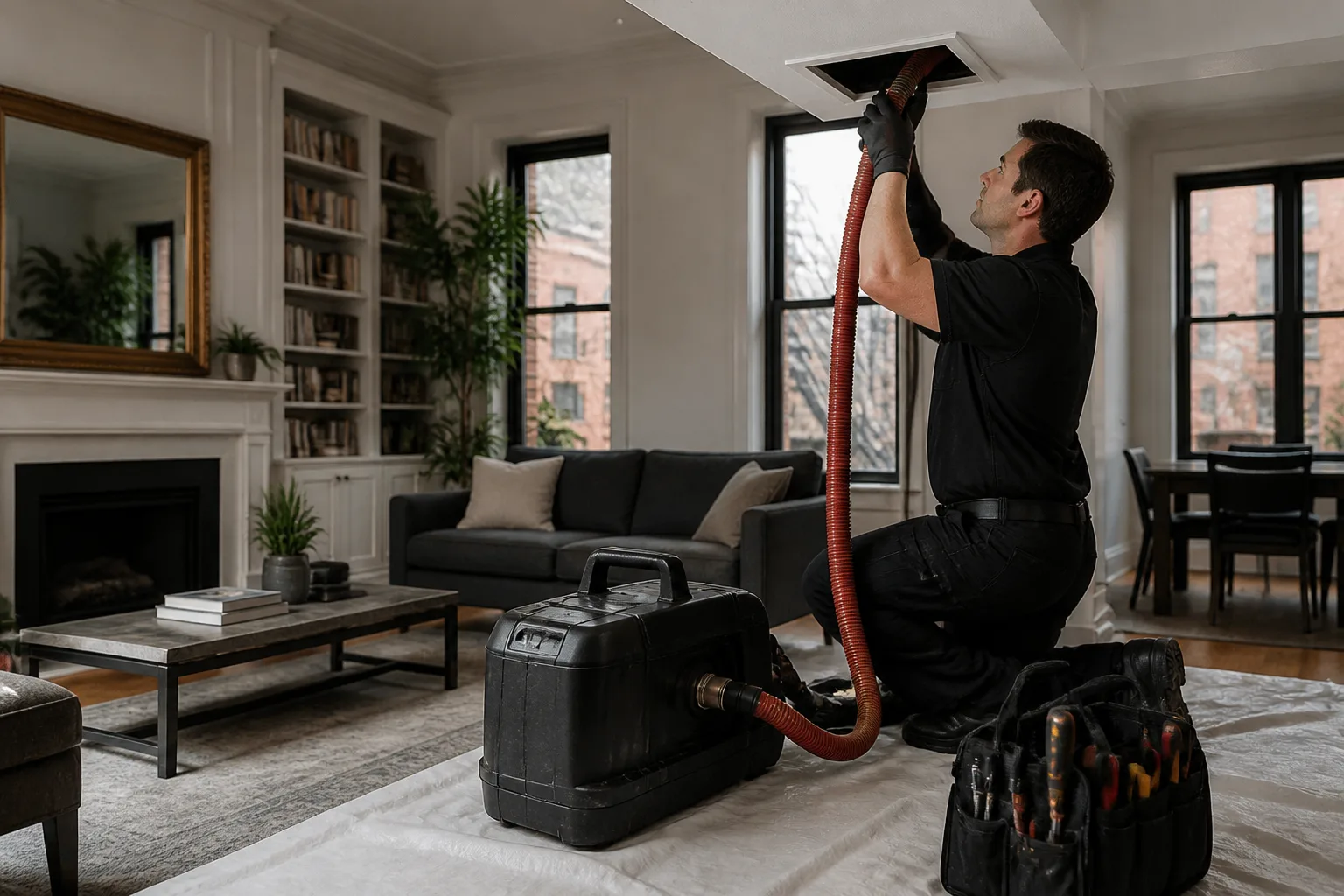
Equipment ownership is the first filter, and it’s the easiest to check. A company doing a complete job in Greenwich Village owns a high-CFM negative-pressure unit (truck-mount or portable for tight access), a rotary brush system, a HEPA vacuum, and a sanitizer capable of UV or fogging treatment. These aren’t tools you rent for a day when a crew happens to book the job.
Here’s why it matters. Duct cleaning works through agitation and extraction: the brush loosens debris and the vacuum pulls it out of the building under negative pressure. If the vacuum can’t keep up with the brush, you’re not cleaning the system. You’re redistributing dirt into the living space. In a converted townhouse with long runs and tight plenum access, that difference shows up fast.
- Rotary brush system for controlled agitation through the full duct length, not just the reachable edges
- High-CFM negative-air unit to hold containment while the brush is running
- HEPA filtration so fine particulate doesn’t settle back into the apartment
- UV or fogging sanitizer for microbial treatment after mechanical cleaning, not as a substitute for it
Ask what equipment a company brings on the truck. An operator who works with professional-grade systems will tell you the manufacturer without hesitation. Our technicians have up to 9 years of experience and run Rotobrush rotary-brush systems and Nikro HVAC cleaning equipment, with Abatement Technologies negative-air units for containment on the more demanding jobs. But don’t take our word for it. Ask the next company you call the same question.
What Does a Proper Pre-Job Inspection Look Like in Greenwich Village?
A proper pre-job inspection in Greenwich Village means camera scoping the duct interior, taking static pressure readings at the air handler, and identifying any asbestos or vermiculite before a single brush enters the system. Any company that skips these steps and goes straight into cleaning is guessing, and in this building stock guessing is expensive.
Here’s what a thorough inspection looks like, in practice:
- Camera scoping to see the actual condition of the duct interior, including the sections you can’t reach from a register
- Static pressure readings at the air handler to establish whether the system is restricted before cleaning begins
- Material identification on duct lining, insulation, and any wrap, because older building stock sometimes carries materials that require handling by a licensed abatement contractor, not a duct-cleaning crew
- Access assessment for tight-ceiling plenum runs, kicked-off turns, and sections where a rotary brush won’t pass through cleanly
- Repair walked through and priced before work starts, so there’s no surprise when a leak is found under the debris
We’ve seen systems in Greenwich Village where a “full cleaning” without inspection left the microbial growth untouched because the crew never looked at the evaporator coil, and systems where a separated trunk fitting let every bit of loosened dust blow straight into a bedroom. Neither problem shows up without looking first.
What Are the Red Flags Unique to NYC Duct Cleaning?
The red flags that matter most in NYC are door-to-door “$99 whole house” offers, crews who quote without asking about system size or duct material, and contractors without a NYC Home Improvement Contractor license. All three say the same thing: the quote isn’t based on the job you have.
The “$99 whole house” pitch is the oldest move in the business. It’s a presence fee, not a job price. Once the crew is inside, the number grows. On the flip side, a contractor who quotes a flat number over the phone without asking how many systems you have, what duct material you’re dealing with, or how accessible the plenum is, hasn’t priced your job at all. They’ve priced a version of it. The final invoice will reflect the difference.
Then there’s the license question. A legitimate duct cleaning contractor working in a NYC co-op or townhouse carries a NYC Home Improvement Contractor license. If you’re dealing with a co-op board or a property manager who needs paperwork on file, ask for it before work is scheduled. The same goes for the contractor’s insurance and their process for confirming insulation type before anyone touches the ducts. A professional answers this without offense. An underqualified operator gets defensive.
The last red flag is the one you don’t notice until after: a company that cleans but doesn’t repair. More on that next.
Why Does It Matter If a Company Also Does Duct Repair and Sealing?
It matters because duct problems are what cleaners find once they open the system. A company that also repairs and seals in the same visit finishes the job. A company that only cleans leaves the problem behind and hands you a phone number.
In Greenwich Village’s older building stock, that difference adds up quickly. Pre-war systems tend to have:
- Leaks at the register boots and fitting joints
- Separated trunk connections caused by decades of expansion and settling
- Collapsed or crushed flex sections in tight ceiling runs
- Gaps around penetrations where the duct meets masonry
Each one undercuts the cleaning. A leaking duct doesn’t just waste heated air in winter. It also pulls unfiltered air from unconditioned spaces into the living area, which is exactly the problem cleaning is supposed to solve. A company that can repair and seal on the same visit closes that loop. If you already know you have a sealing issue, our air duct cleaning service covers the full scope. If you’re not sure, ask the contractor during the inspection.
Five Questions That Separate Technical Contractors From Salespeople
These five questions are the fastest way to tell a qualified operator from an underqualified one. A technical professional answers all five without looking it up. A salesperson deflects.
- “What’s the negative pressure setup on this job?” A real answer involves the unit, the CFM range, and containment. A vague one sounds like “we have a big vacuum.”
- “How do you confirm what insulation or wrap we have before you start?” The answer should mention visual inspection, material ID, and what they do if they find something that needs abatement.
- “Is your rotary brush system truck-mounted or portable for this access?” A contractor who knows the building stock will ask whether there’s service access or if the truck has to stay on the street.
- “If you find a leak or a separated fitting during cleaning, what happens?” The answer tells you whether the company repairs and seals in the same visit or hands it off.
- “Will you camera-scope the interior before and after?” A full-cycle company does. A one-step company doesn’t, because they don’t want the before-and-after recorded.
That last question matters more than most homeowners expect. Proper cleaning is documented with camera footage on both ends, so you can see what was there before and what’s there after. If a company can’t show you that, you can’t verify what they did. If you also want the full HVAC system looked at while a technician is on-site, our HVAC cleaning work addresses the air handler, coil, and blower, which is where a lot of the microbial growth in older systems actually lives.
When to Call a Pro (and When to Wait)
Not every apartment needs duct cleaning. If you’ve lived somewhere ten years, the system has never been touched, and you’re seeing visible debris or hearing the system cycle harder, it’s time. If you’ve just moved in and the previous owner’s maintenance history is a mystery, an inspection is cheap insurance. If your ducts were professionally cleaned within the last few years and nothing has changed, waiting is fine.
The triggers worth calling about in Greenwich Village:
- Visible dust or debris blowing from registers after the system starts up
- Musty or stale smells that appear only when the HVAC runs
- Allergy or asthma symptoms that get worse indoors, not better
- An older system that hasn’t been scoped or cleaned in years, especially in a co-op or townhouse with tight plenum runs
- Renovation dust from nearby construction that worked its way into the return
One more service worth mentioning: dryer vent cleaning is part of what we offer, and it’s the one item on the list most HVAC-only cleaners decline because it isn’t ductwork. A clogged dryer vent is a real fire risk, and it’s usually caught during a routine system inspection.
Related services in Greenwich Village: air duct cleaning, HVAC cleaning, duct repair and sealing, air quality and sanitizing, and dryer vent cleaning.
If you’d rather not work through the checklist alone, call (855) 337-2008. We answer 24/7. Fast dispatch from 7am to 7pm, Sunday through Friday. Estimates are free.
The Bottom Line
Credentials are the floor, not the ceiling. A NADCA certification, a long review history, or a friendly website all tell you the company passed a baseline. They don’t tell you whether they’ve ever worked in a 1920s co-op with a converted townhouse plenum that changes dimensions three times before it reaches the register. The questions above do.
The short version:
- The company should own its equipment, not rent it, and be able to name what it uses
- Inspection comes before cleaning, every time, and includes camera scoping and material identification
- A NYC Home Improvement Contractor license and a written, per-job estimate are non-negotiable
- Duct repair and sealing in the same visit is a structural advantage in older buildings
- Five questions on the phone settle it faster than any review score
If you’re in Greenwich Village and need help, Air Duct Cleaning Greenwich Village offers free estimates. Call (855) 337-2008. We answer 24/7, with fast dispatch from 7am to 7pm, Sunday through Friday. The price is set per job by the written estimate, agreed before any work starts, and we document the job with before-and-after photos of your own system.
Frequently Asked Questions
Ask them to describe their pre-job inspection. A qualified company for older Greenwich Village buildings will talk about camera scoping, static pressure readings, and identifying insulation or wrap before mechanical agitation begins. If the answer is “we just clean the ducts,” they haven’t worked this building stock.
Low quotes are usually based on a job the company hasn’t seen. They skip inspection, use smaller equipment, and price the cleaning only. Any repair or sealing needed is billed separately once the crew is on-site. A written, per-job estimate based on your actual system is the only number worth comparing. Call (855) 337-2008 for an exact quote, and the estimate is free.
Yes. Any contractor performing work in a NYC co-op or residential building should carry a NYC Home Improvement Contractor license. Co-op boards and property managers typically ask for proof before scheduling. Ask for the license number, insurance certificate, and a written estimate before booking.
Most systems need it every three to five years, depending on system age, dust load, and whether any renovation happened in the building. Systems in older co-ops and townhouses sometimes need it sooner because of gaps, leaks, and restricted plenum runs. An inspection tells you what your system actually needs. Call (855) 337-2008. We answer 24/7. Fast dispatch from 7am to 7pm, Sunday through Friday.
Written by the team at Air Duct Cleaning Greenwich Village.
Need Air Duct Cleaning Help?
Call Air Duct Cleaning Greenwich Village - the local pro we connect you with is licensed and insured, with free written estimates in Greenwich Village.
(855) 337-2008