
Nikro Air Duct Cleaning in Greenwich Village: A Homeowner’s Guide
Most duct cleaning rigs move air at 1,500 to 3,000 CFM. A Nikro HEPA-filtered negative-pressure unit pulls up to 5,000 CFM, and that pressure differential is the whole reason debris leaves your ductwork instead of blowing back into your rooms. Understanding what Nikro equipment actually does helps Greenwich Village homeowners spot the difference between real cleaning and a shop-vac dressed up as a full job. Here’s how it works, what it can’t do alone, and how to tell whether a crew is genuinely running one.
If you’d rather leave the ducts to someone with the right machine, call (855) 337-2008.
Why pressure differential matters more than vacuum power alone
A vacuum is only as good as the seal around it. Consumer machines and improvised rigs pull decent numbers on paper, but they lose that pull the moment a register isn’t tightly connected. Air takes the path of least resistance, which in an apartment is usually your living room. A Nikro unit is a continuous-duty negative-pressure system with HEPA filtration. It pulls the whole duct run into controlled vacuum, so the dust you dislodge goes into a filter instead of into the air your family breathes.
That distinction matters most in Greenwich Village’s pre-war buildings, where a single duct run often crosses several units. A weak vacuum lets loose debris migrate through shared chases toward a neighboring apartment. Negative pressure keeps the workzone inside the system. We’ve seen jobs where the visible result looked fine and the air smelled worse afterward, which is usually a containment problem, not a cleaning problem.
A Nikro system does four things well:
- Continuous-duty extraction across long mechanical runs without the motor fading mid-job.
- HEPA filtration that captures fine particulate before it reaches the exhaust.
- Negative-pressure containment that prevents cross-contamination into occupied living spaces.
- Portable configuration that fits narrow mechanical rooms and stairwells common in converted townhouses.
What it can’t do is agitate caked-on debris inside the duct walls. That’s a separate job, and it’s why a complete cleaning pairs Nikro with an Air Duct Cleaning Greenwich Village process built around rotary agitation rather than vacuum alone.
How a Nikro job prevents cross-contamination in pre-war buildings
Negative-air containment is the standard you’d expect during mold and hazardous-material remediation, and it’s the approach we use on residential ductwork too. Abatement Technologies negative-air units run alongside the cleaning to hold a pressure boundary around the work area. Filtered exhaust moves away from living spaces, not through them. In older Manhattan buildings with shared duct chases, that boundary is the difference between cleaning one apartment’s ducts and redistributing debris across a floor.
Nikro’s HEPA cartridge handles the same idea at the machine itself. It filters the air it pulls before it exhausts it, which is critical in a three-flight walkup with no mechanical room and a return grille six feet from where you sleep. NADCA’s guidance for occupied residential spaces leans on exactly this configuration: seal the system, maintain negative pressure, filter the exhaust. When a crew skips that setup, the cleanup afterward tells the story. A fine film of dust on the furniture after a “clean” job isn’t a coincidence. It’s a filtration failure.
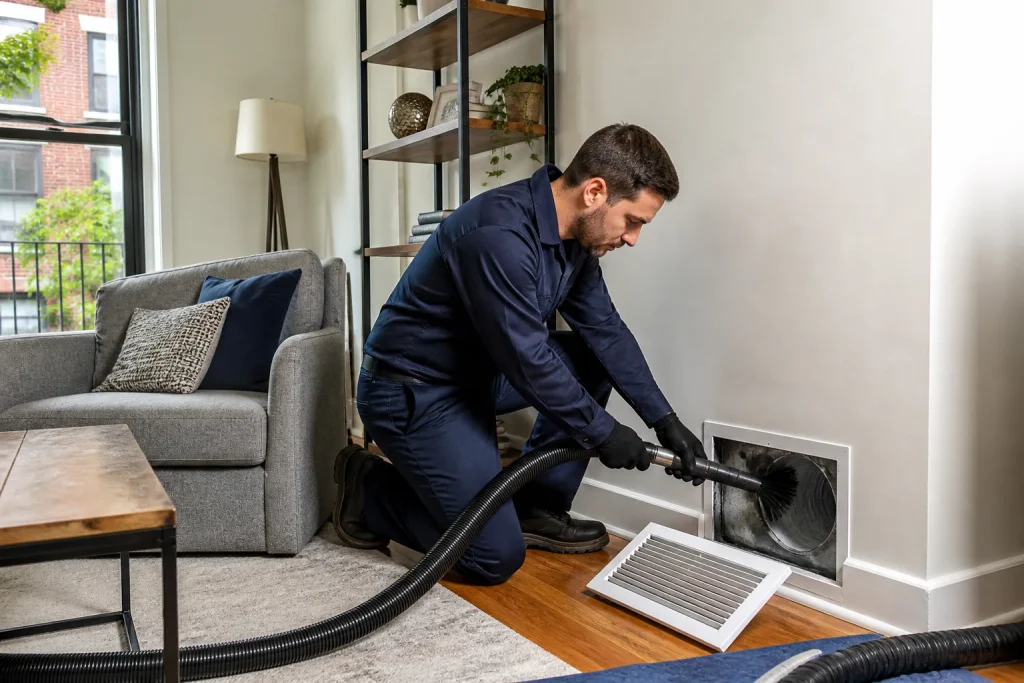
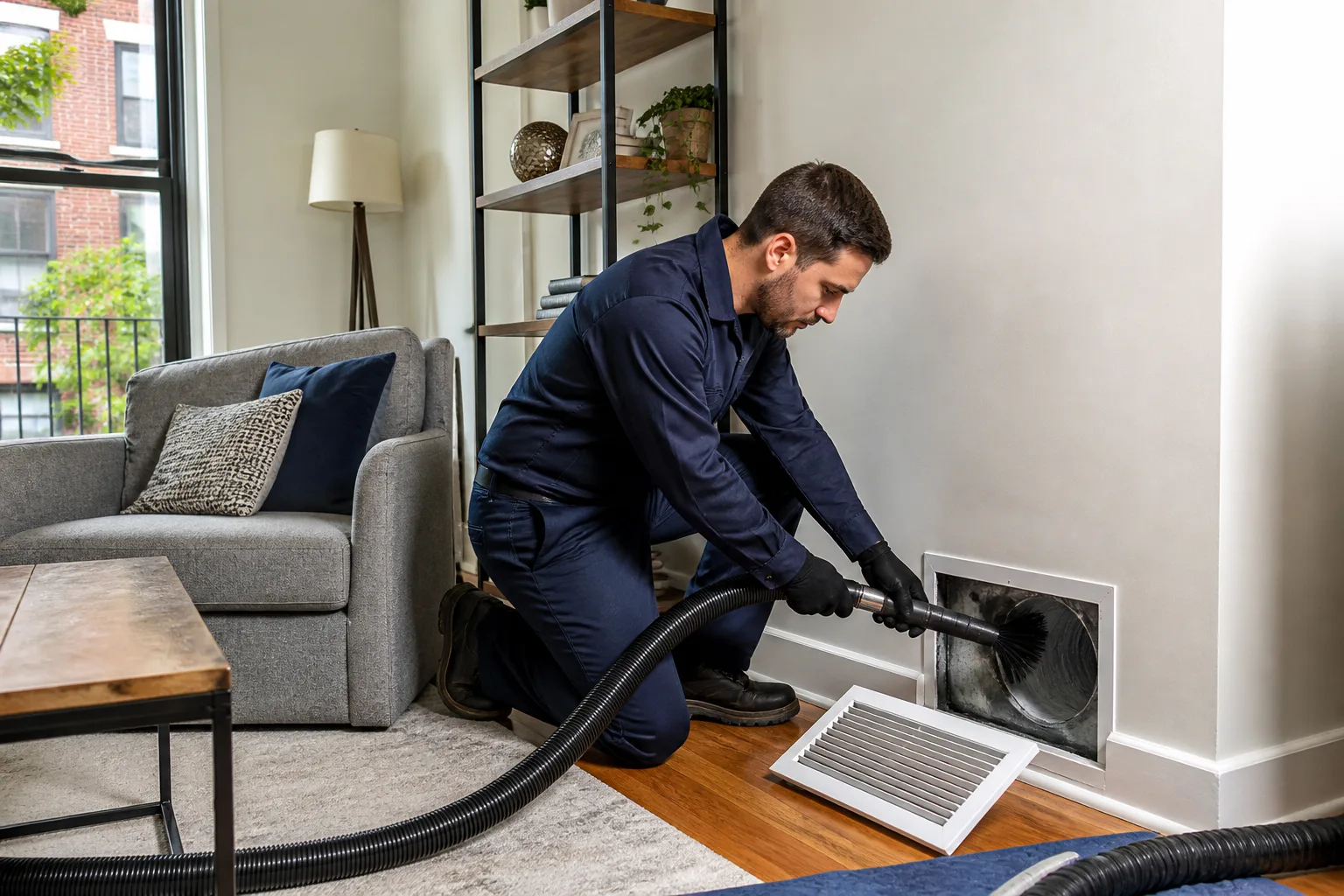
A properly contained job usually looks boring from the living room. You hear the machine, you see the hoses, and you don’t see a dust cloud. That’s the point.
Nikro and Rotobrush: why they work together, not against each other
Nikro’s vacuum system and Rotobrush’s rotary-brush head solve two different problems, and a thorough job needs both. Nikro creates the negative pressure that holds debris in the system. Rotobrush does the agitation: the rotating brush head walks the duct interior, breaking loose the compacted dust, hair, and lint that gravity has pressed into the sheet metal over years of use. Vacuum alone glides past that layer. Agitation alone throws dust into the air. Together, the brush loosens and the vacuum captures.
Homeowners sometimes ask why one machine can’t do it all. Here’s the short answer:
- Rotobrush agitates the dust bonded to the duct walls, register boxes, and plenum surfaces.
- Nikro extracts the loosened material under sustained negative pressure, filtering the exhaust.
- Guardsman-class antimicrobial treatment follows on the cleaned surface when microbial growth is present, applied only after extraction is complete.
- Honeywell and Aprilaire components are checked for the airflow and filter interaction the cleaning may have affected.
If a quote describes a “full duct cleaning” with one machine and no explanation of how the debris gets captured, that’s the moment to ask what happens to the air on the exhaust side. Greenwich Village apartments don’t tolerate a vague answer.
Local duct conditions that Nikro’s portable setup handles well
Greenwich Village’s housing stock creates three conditions a bulky truck-mounted rig struggles with. Cast-iron register boxes in pre-war buildings have irregular interior surfaces that trap decades of dust and require careful agitation without cracking the casting. Narrow flex-duct runs in converted townhouses leave little room for a brush head to navigate, so the machine has to run at lower pressure to avoid crimping the duct. And tight mechanical rooms in walk-ups mean the equipment has to break down small and reassemble in a closet-sized space.
Nikro units are configured for this. They’re portable, they run on standard power, and they maintain negative pressure through a run that a truck-mounted hose couldn’t reach from the street. That portability is why the same equipment shows up in NADCA-compliant commercial projects, where access is complicated and containment is mandatory. In our experience, a proper HVAC cleaning in a Greenwich Village townhouse starts with figuring out where the machine can physically sit and still hold pressure, not with how many vents are in the apartment.
Dryer vents are a different animal, but they matter here too. Converted townhouses often route dryer exhaust through long, curving runs behind kitchen walls, and lint builds up in the low spots. That’s a documented fire risk, and dryer vent cleaning belongs on the same visit if the run hasn’t been touched in years.
How to verify a contractor is actually using Nikro equipment
Nearly every duct cleaner claims professional equipment. Fewer can show it. The questions below are the ones that separate a real Nikro setup from a marketing line. Ask them before the appointment, and ask to see the equipment at the door if you’re unsure.
- “What’s the model number on your vacuum unit?” A Nikro user can answer. A shop-vac rig can’t.
- “How do you maintain negative pressure during extraction?” The answer should mention sealed registers and filtered exhaust, not just “we use a big vacuum.”
- “Is the machine HEPA-filtered?” HEPA filtration is what prevents cross-contamination in shared-chase buildings.
- “What equipment handles the agitation step?” Look for a rotary-brush system like Rotobrush, not a whip or air-jet alone.
- “Do you set up containment before cleaning begins?” Negative-air units should be in place before the first register is opened.
- “Can you show me before-and-after photos of the duct interior?” A camera inspection is how you verify the work, not a verbal summary.
If the answers are vague on all six, the equipment probably is too. For a broader comparison of what a full-service air duct cleaning visit should include from start to finish in Greenwich Village, that page walks through the whole sequence.
When to call a pro instead of trying this yourself
Consumer-grade vacuums and DIY brush kits can reach a straight run in a newer building. They can’t hold negative pressure, they can’t filter fine particulate, and they can’t inspect what they can’t see. More importantly, a poorly sealed job in a Greenwich Village pre-war building doesn’t just underachieve. It can push dust into a neighboring unit through a shared chase. That’s not a risk worth taking on to save the cost of a professional visit.
Call a professional when you notice:
- Musty odors coming from registers when the system starts up.
- Visible dust on furniture within a day or two of cleaning.
- Allergy symptoms that ease when you leave the apartment and return when you get back.
- Long lint buildup in the dryer vent run.
- An aging system in a building where ductwork has never been inspected.
Our technicians have up to 9 years of experience with professional-grade Rotobrush, Nikro, and Abatement Technologies equipment, and we can work with your Honeywell or Aprilaire system rather than around it.
Related services in Greenwich Village: Air Duct Cleaning Greenwich Village covers the full service menu, alongside HVAC cleaning and dryer vent cleaning for the same visit.
The Bottom Line
Nikro’s negative-pressure system does work a portable shop-vac physically cannot: it holds the whole duct run at negative pressure, filters the exhaust through a HEPA cartridge, and keeps debris out of your living space during extraction. That matters in Greenwich Village’s pre-war buildings, where duct runs cross multiple units and a weak vacuum redistributes the problem instead of solving it. Nikro pairs with Rotobrush agitation because one loosens and the other captures, and any quote that describes a one-machine job is leaving half the work on the table.
If you’re in Greenwich Village and need help, Air Duct Cleaning Greenwich Village offers free estimates. Call (855) 337-2008. We answer 24/7. Fast dispatch from 7am to 7pm, Sunday through Friday.
Frequently Asked Questions
Nikro air duct cleaning uses a continuous-duty, HEPA-filtered negative-pressure vacuum system to pull debris out of ductwork while holding the whole run under controlled vacuum. The HEPA cartridge filters the exhaust before it leaves the machine, which prevents fine particulate from re-entering the living space during extraction. It’s the same class of equipment specified in NADCA-compliant commercial projects, applied to residential work.
It’s a continuous-duty machine rated up to 5,000 CFM with HEPA filtration and negative-pressure containment, versus a consumer vacuum adapted for HVAC work at far lower volume and without filtration on the exhaust side. In shared-chase buildings like Greenwich Village’s pre-war stock, that difference decides whether debris stays in the system or migrates to a neighboring unit. The equipment is purpose-built, not improvised.
No. Nikro extracts; Rotobrush agitates. The rotary brush breaks loose the compacted dust bonded to the duct walls, and the Nikro vacuum captures it under negative pressure. A complete cleaning uses both, along with antimicrobial treatment and a camera check to verify the result.
Ask for before-and-after photos of the duct interior from a camera inspection, and ask for the model number of the vacuum unit at the start of the visit. A crew running Nikro equipment can tell you which machine they’re using and show you the containment setup before the first register is opened. Call (855) 337-2008 for a free estimate and a straight answer on what the job involves.
Written by the team at Air Duct Cleaning Greenwich Village.
Need Air Duct Cleaning Help?
Call Air Duct Cleaning Greenwich Village - the local pro we connect you with is licensed and insured, with free written estimates in Greenwich Village.
(855) 337-2008